

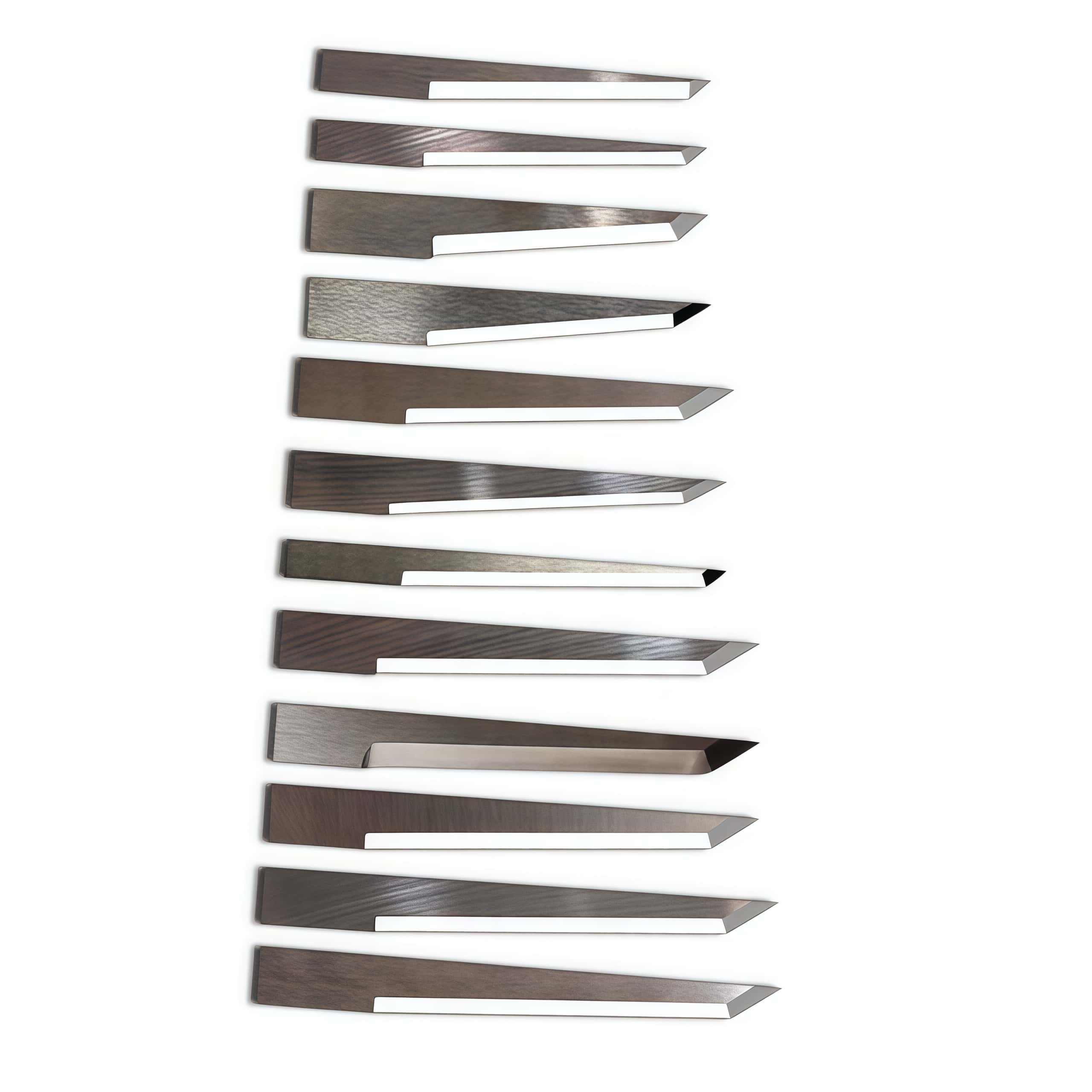
The term HM generally denotes cemented carbides, most commonly tungsten carbide (WC) bound with cobalt or nickel. It resembles concrete in structure, where WC grains act as the "aggregate," and the cobalt binder serves as the "cement," adding durability. Additional carbides like titanium or tantalum can be mixed in to enhance wear properties, corrosion resistance, and toughness for specific applications.
Key Features of Tungsten Carbide Blades
- Exceptional Hardness: With a Mohs scale rating of 8–9, WC rivals or exceeds the hardness of typical knife steels, enabling extended edge retention.
- Wear Resistance: Tungsten carbide is reported to be 3–9 times harder and more resistant to wear than conventional tool steels, making it ideal for abrasive environments.
- Improved Toughness vs Ceramics: The cobalt matrix grants these blades better resistance to impact and shock compared to ceramic blades, which are prone to chipping or breaking at similar hardness levels.
- Heat Tolerance: WC blades maintain their hardness at elevated temperatures (up to approximately 1,000°C), proving valuable in high-speed or friction-intense cutting applications.
Advantages for Knife Applications
- Prolonged Edge Retention: Suited for abrasive tasks such as cutting fiberglass, filled plastics, textiles, paper, rubber, or nonferrous metals; fewer replacements increase productivity.
- Dimensional Stability: Retains edge geometry over millions of cycles in industrial processes, optimal for slitter knives, granulator knives, and similar technical usages.
- Corrosion and Abrasion Resistance: Ideal for outdoor, survival, and hunting knives exposed to harsh conditions like moisture, dust, or grit.
Design Considerations and Limitations
- Brittle Nature Compared to Steel: Cemented carbides are less flexible than high-quality knife steels, so thicker and well-supported blade profiles are preferred to prevent breakage.
- Special Sharpening Tools Required: Due to its hardness, WC requires diamond abrasives for sharpening; typical aluminum-oxide or silicon-carbide tools are insufficient.
- Initial Costs: Manufacturing blades from tungsten carbide is relatively expensive compared to carbon or stainless steel, making them best suited for applications that justify their long-term savings.
Typical Tungsten Carbide Knife Functions
These blades excel in industries requiring high-performance cutting tools:
- Industrial slitting and conversion operations involving films, foils, paper, and textiles where clean cuts are essential.
- Recycling equipment like granulators handling abrasive materials such as plastics, composites, or rubber containing contaminants.
- Specialized outdoor and survival knives that demand unmatched edge retention and durability in challenging environments.
Oyea Knives is an expert manufacturer of tungsten carbide products since 2007, specializing in carbide knives and blades across various industries. These include Paper, Metal, Film and Foils, Textiles, Corrugated Cardboard, PCB, Plastic, Wood, Asbestos, Packaging, Printing, Tobacco, Fiber, Rubber, Nonwovens, Bookbinding, Tube and Pipe manufacturing, among others. We tailor our products based on customer-specific material requirements.
Additionally, we produce knives, spare components, and cutting underlays for numerous machines such as ATOM ZUND, LECTRA HUMANTEC SABAL MCT GERBER AGFA BLACKMAN & WHITE SUMMA TALAMONI, among others used worldwide in diverse industrial processes.
SHARE:


PREV : Trend analysis of tungsten carbide powder prices and reasons behind fluctuations NEXT : China Non-standard Customization Tungsten Steel Knives Knife Blade