

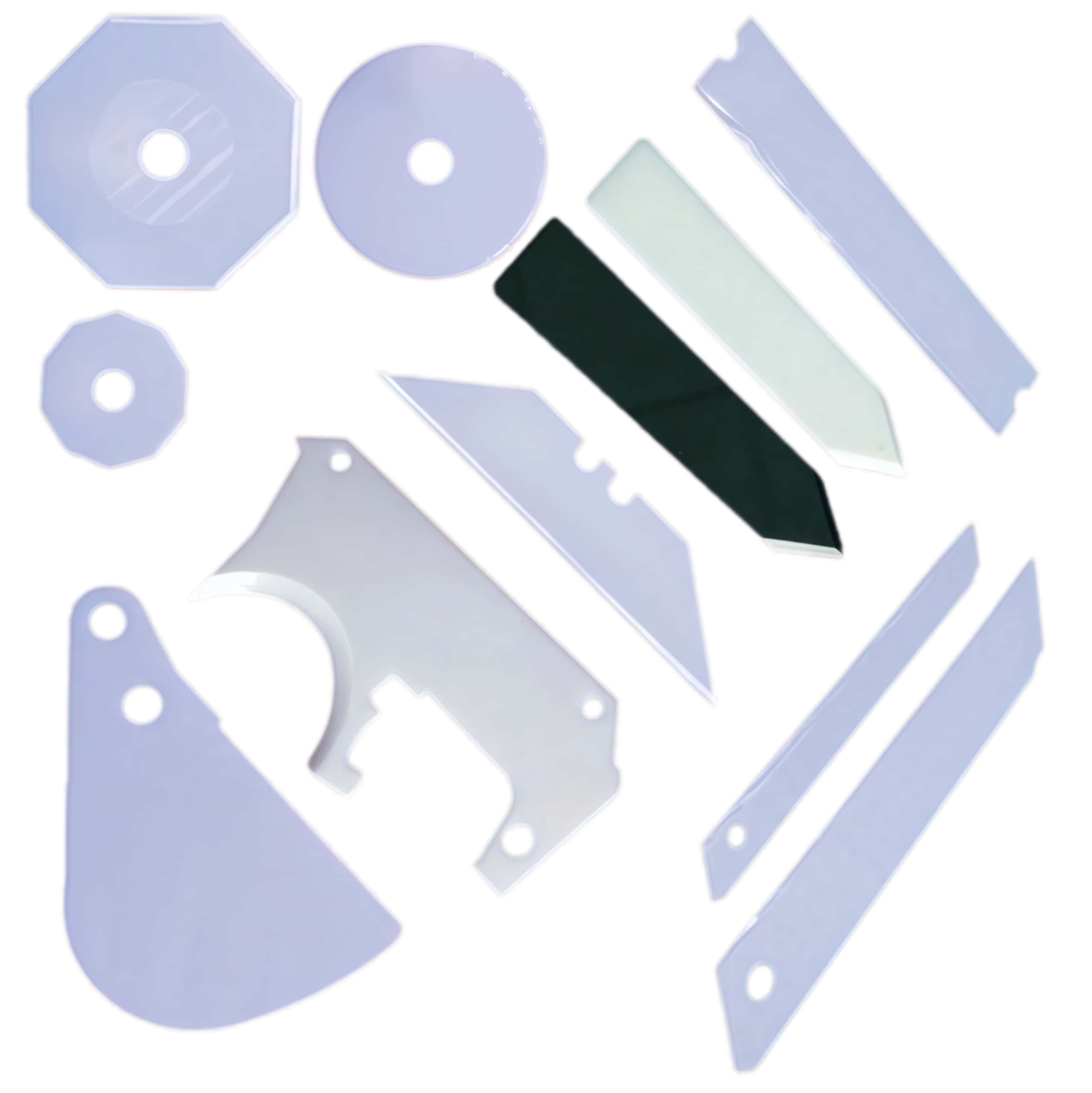
Production Process Overview
The manufacturing process consists of the following stages:
1. Raw Material Preparation
High-purity zirconia powder is blended with binders and stabilizers, typically yttria (Y₂O₃), to form a uniform slurry.
2. Granulation
The slurry undergoes spray-drying to produce fine granulated powder particles, approximately 1 micron in size, ensuring consistent density during pressing.
3. Molding/Pressing
- Dry Pressing: Granulated powder is loaded into blade-shaped molds and compressed under high pressure, often exceeding 1 ton/cm².
- Cold Isostatic Pressing (CIP): Produces higher-density compacts by applying uniform pressure from all directions.
- njection Molding: Suitable for creating intricate geometries, though it requires more costly tooling.
4. Sintering
The compressed "green" blanks are sintered in kilns at 1350°C to 1700°C (and sometimes up to 2000°C) for 2–6 days. During this step, the material undergoes shrinkage to about 75% of its original size while achieving high density.
5. Hot Isostatic Pressing (HIP)
This optional step follows sintering to eliminate internal porosity and further enhance mechanical strength, ensuring superior toughness.
6. Machining and Sharpening
Due to the extreme hardness of zirconia (approximately 8.5 on the Mohs scale), sintered blanks are shaped and sharpened using diamond-coated grinding wheels.
7. Polishing and Finishing
Blades are polished to achieve a smooth surface—often reaching a surface roughness of Ra0.1μm or better—to deliver ultimate sharpness and a refined finish.
Key Technical Specifications
-Material:Yttria-stabilized zirconia (Y₂O₃-ZrO₂).
- Hardness:Approximately 8.5 on the Mohs scale (hardened steel measures between 7.5–8).
-Dimensions:Minimum blade thickness can reach as little as 0.2 mm.
- Tolerances: Precision grinding allows for tolerances as tight as ±0.002 mm.
- Color Options: Typically white or black, with additional colorings (achieved using carbides or nitrides) for aesthetic or specialized industrial requirements.
Key Considerations
- Brittleness: Despite their significant hardness and wear resistance, zirconia blades remain brittle and may chip if dropped or subjected to twisting/leveraging forces.
- Weight: Ceramic blades are about 50% lighter than steel counterparts, reducing user fatigue in industrial settings.
- Applications: Zirconia blades are favored in specialized fields requiring long-lasting performance—examples include film slitting, medical tools, and food processing equipment.
SHARE:


PREV : Differentiate between using Tungsten Carbide and Zirconia Ceramic Blades NEXT : Knives Knife Blades for Zund CNC Digital Cutting Systems