

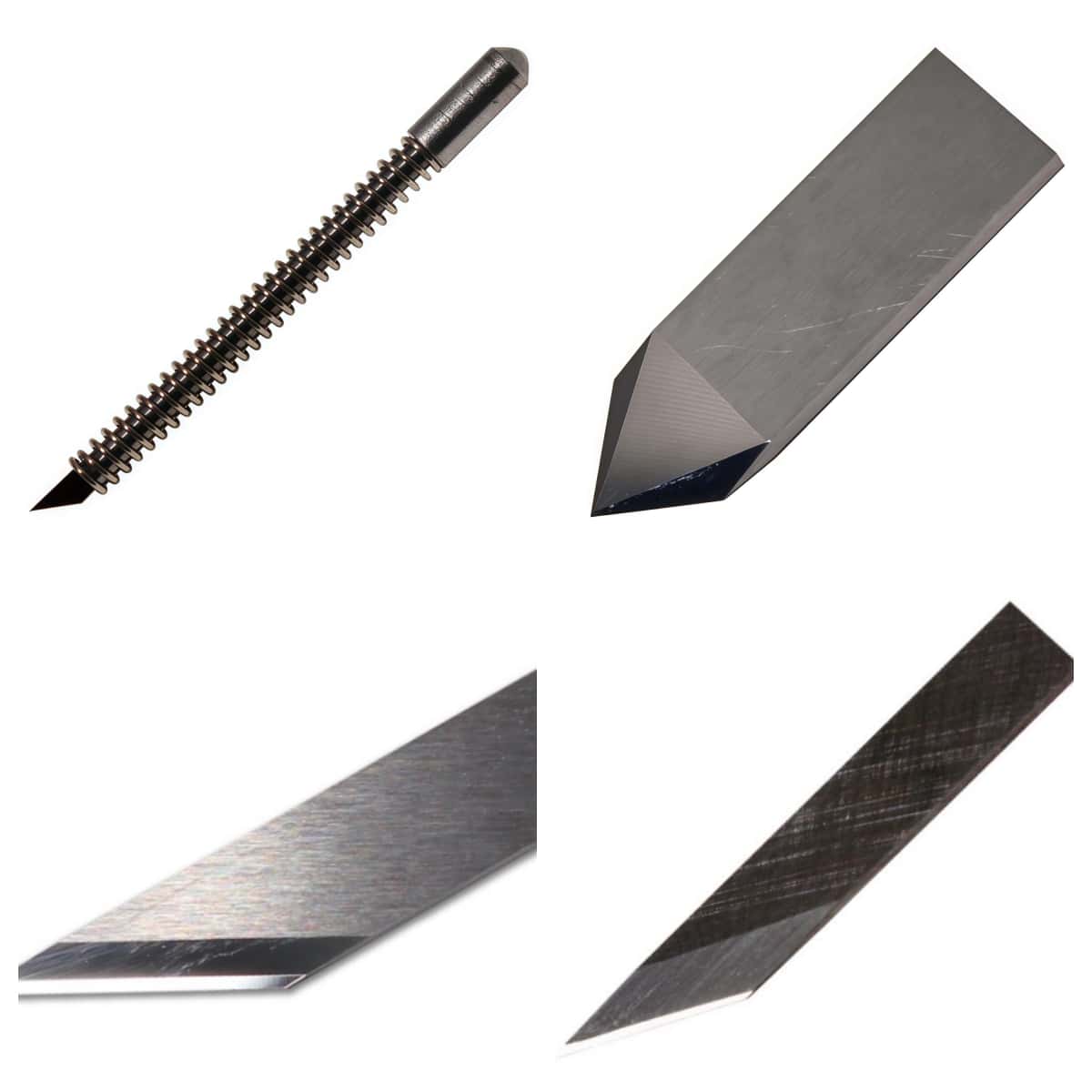
Blade Types by Mechanism
The Colex system is equipped with a triple-interchangeable head that accommodates various tool-driven blades for versatile cutting applications.
- Oscillating Blades: Designed for thick, dense, or porous materials, these blades use oscillating strokes to "saw" through substrates.
- Standard (1.5mm stroke): Suitable for materials like corrugated stock, honeycomb board, and foam board.
- Long/Special (3mm stroke): Recommended for cutting thicker foam media, up to 2 inches in thickness.
- Static / Drag Knife Blades: Ideal for general-purpose cutting of thinner or more flexible materials.
- Double Edge: Perfect for cutting curved shapes and tight radii, as both edges remain sharp.
- Single Edge: Best for creating straight lines and broad curves in rigid materials such as expanded PVC (Sintra) or styrene.
- Rotary Blades: Equipped with a 10-sided rotating wheel, these blades excel at cutting textiles, fabrics, and other fibrous materials that may snag with traditional blades.
Specialty Knives
- Kiss-Cutting: Specifically designed for creating decals and labels by cutting through only the top layer while leaving the backing intact.
- V-Cut / Bevel Blades: Used for crafting folds (ranging from 90° to 150° angles) in materials like honeycomb or corrugated board, making them ideal for creating 3D structures.
Choosing the right blade ensures optimal performance and precision tailored to your specific project needs.
Selection Guide by Material
| Material | Recommended Blade/Tool | Common Blade Models |
|---|---|---|
| Vinyl / Labels | Kiss-Cutting or Drag Knife | T00212, T00313 (60°) |
| Foam / Honeycomb | Oscillating or Universal Single Edge | T00418, T00139 |
| Coroplast | Coroplast Knife | T00335 (30°), T00336 (45°) |
| Fabrics / Textiles | Rotary Knife | T00143 |
| Expanded PVC | Fixed Double Edge or Universal Single Edge | T00120, T00312 (80°) |
Key Considerations for Blade Selection
Blade Length: Opt for a blade that extends at least 5mm beyond the thickness of your material to guarantee a clean and precise cut.
Blade Angle: For denser materials, choose blades with lower angles (30°–35°), while steeper angles (60°–80°) are ideal for standard vinyl or intricate detailing.
Rigidity: Use thicker blades, such as 1.5mm, to enhance rigidity and avoid blade deflection, which is essential for precise cutting in hard materials.
Blade Offset: Whenever you change blade angles, adjust the offset settings in your cutter software to ensure continued cutting accuracy.


SHARE:


PREV : How To Set Correct Blades Depth On Colex Sharpcut Cutters NEXT : Differences and similarities between Zund G3, S3, D3, L3 digital cutting blades